
A Strategic Decision Framework for CMOs and Marketing Directors
Choosing between an independent SEO consultant and an in-house SEO manager is not about talent. It is about context.
After 15 years working both agency-side and in-house, I have seen strong companies fail with the wrong model and average companies outperform with the right one. The real decision is structural, not personal.
Below is a practical framework to help you evaluate which path fits your business stage, internal culture, and growth objectives.
From the Trenches: Two Very Different Operating Environments
A Day in the Life of an Independent SEO Consultant
A consultant’s day is fragmented by design.
- Morning: Technical audit for a SaaS company struggling with crawl budget issues.
- Midday: Strategy call for an eCommerce brand facing SERP fluctuation after a Google update.
- Afternoon: Competitive entity-mapping research for a fintech startup.
- Evening: Executive summary deck for a board presentation.
Consultants operate in high-velocity environments. They pivot quickly across industries, algorithms, and technical stacks. Their exposure to multiple verticals gives them pattern recognition across:
- Indexation problems
- Core Web Vitals instability
- Entity-based SEO gaps
- Internal linking inefficiencies
- Algorithm recovery playbooks
- Lack of backlink flow
They are trained to diagnose, prioritize, and recommend.
Execution often depends on someone else.
A Day in the Life of an In-House SEO Manager
An SEO manager operates in depth rather than breadth.
- – Standup meeting with dev team about JavaScript rendering issues.
- – Alignment discussion with content about topical authority clusters.
- – Negotiation with product over canonicalization conflicts.
- – Reporting to CMO on attribution modeling impact.
An in-house manager lives inside the system.
They deal with:
- – Dev sprint queues
- – PR calendar alignment
- – Internal stakeholder resistance
- – Long-term roadmap integration
Where consultants move fast across environments, managers move slowly but influence deeply.
They build infrastructure rather than deliver isolated wins.
The Core Decision Framework
There is no universal answer. The correct choice depends on four structural variables:
- Technical debt
- Internal culture
- Growth velocity
- Organizational maturity
Let’s break each down.
1. Technical Debt: Overhaul vs. Maintenance
When a Consultant Is Better
If your site has:
- – Massive crawl inefficiencies
- – Structural index bloat
- – Broken internal linking architecture
- – Migration disasters
- – Declining rankings from algorithm updates
You likely need a high-intensity technical overhaul.
Consultants excel at:
- One-time audits
- Forensic traffic loss analysis
- Re-architecture roadmaps
- Entity-based topical gap mapping
- Competitive reverse-engineering
They come in, identify structural failures, and design a recovery blueprint.
This is especially true if you need:
- – A 90-day turnaround plan
- – Board-level reporting clarity
- – External validation for urgent changes
When an In-House Manager Is Better
If your site is technically stable but needs:
- – Continuous content optimization
- – Ongoing internal linking refinement
- – Incremental CRO + SEO alignment
- – Cross-functional collaboration
Then a full-time manager is more effective.
SEO is not always about dramatic fixes. Mature companies need:
- – Controlled experimentation
- – Regular content refresh cycles
- – Ongoing crawl health monitoring
- – Search intent refinement
That requires presence, not periodic intervention.
2. Internal Culture: The Outside Voice vs. The Diplomat
Consultant as the External Authority
Consultants carry psychological weight internally.
They often function as:
- – A neutral third party
- – A credibility amplifier
- – A change catalyst
If internal teams resist SEO recommendations, an external expert can reset the conversation.
Example scenarios:
- – Developers dismiss SEO priorities
- – Leadership underestimates organic growth potential
- – PR team operates without search alignment
In these cases, an outside voice cuts through internal politics.
However, consultants rarely control implementation speed.
Manager as the Diplomatic Operator
An in-house manager understands internal power structures.
They know:
- – Which dev lead influences backlog decisions
- – How marketing KPIs are prioritized
- – Where budget approvals stall
They build long-term stakeholder alignment.
Instead of forcing change, they negotiate it.
This is critical in enterprise environments where SEO must integrate with:
- – Product
- – UX
- – Engineering
- – Content
- – PR
Without internal diplomacy, even the best strategy remains a slide deck.
Independent SEO Consultant vs. In-House SEO Manager Cost Comparison
Below is a simplified comparison.
|
Factor |
Independent SEO Consultant |
In-House SEO Manager |
|
Cost Structure |
Hourly ($150–$350/per hr) or Retainer ($3k–$15k/month typical) |
Salary ($80k–$150k+) + Benefits + Bonuses |
|
Total Annual Cost |
Flexible, scalable |
Higher fixed overhead |
|
Speed of Implementation |
Fast strategy delivery, dependent on internal team |
Slower ramp, stronger execution continuity |
|
Strategic Breadth |
High across industries |
Deep within one brand |
|
Institutional Knowledge |
External |
Internal long-term retention |
|
Scalability |
Can scale up/down quickly |
Requires hiring/firing cycle |
Cost is rarely the deciding factor alone. Flexibility often matters more than raw expense.
The Accountability Gap
This is often overlooked.
Consultant Accountability
- – Accountable to contract deliverables
- – Accountable to defined KPIs
- – Easily replaced if performance stalls
Their leverage comes from performance-based retention.
If traffic does not grow, renewal conversations change quickly.
Manager Accountability
- – Accountable to culture and team dynamics
- – Measured by collaboration as much as performance
- – Harder to replace without disruption
Their influence is structural rather than transactional.
The consultant answers to outcomes.
The manager answers to outcomes plus organizational health.
Scalability Factor
Consultant Model
- – Can be “switched off” during budget constraints
- – Can scale engagement during site migrations
- – Ideal for project-based acceleration
This model suits companies with fluctuating needs.
Manager Model
- – Builds repeatable processes
- – Trains junior team members
- – Creates SEO documentation systems
- – Establishes entity authority frameworks
Over time, this compounds.
If you plan to build a content engine or international expansion strategy, in-house leadership creates durable infrastructure.
Integration vs. Isolation
Below is a simplified operational comparison.
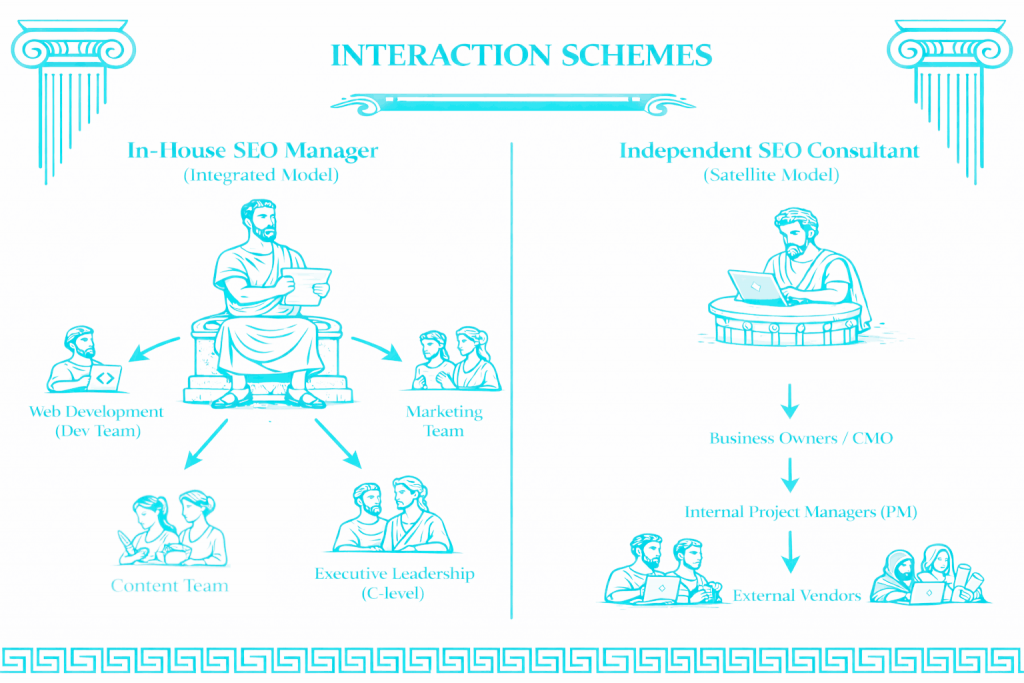
Strategic Breadth vs. Depth
Consultants Bring Breadth
Because they work across industries, consultants often see:
- – Emerging SERP feature shifts
- – AI-driven search behavior changes
- – Entity graph updates
- – Structured data experimentation trends
They recognize patterns early.
This is particularly useful during:
- – SERP fluctuations
- – Core algorithm shifts
- – Competitive ranking displacement
Managers Build Depth
An in-house manager understands:
- – Brand narrative
- – Historical technical decisions
- – Internal content politics
- – Data inconsistencies across departments
They refine instead of rebuild.
Long-term SEO success depends on consistency more than clever tactics.
Hidden Risks on Both Sides
Consultant Risks
- – Limited internal buy-in
- – Dependency on internal execution speed
- – Risk of generic frameworks applied without full brand immersion
- – Potential short-term mindset if contract duration is limited
Consultants can design excellent strategies that never get implemented.
In-House Manager Risks
- Silo blindness
- Reduced exposure to cross-industry innovation
- Professional stagnation
- Over-alignment with internal limitations
Managers can become too comfortable with existing constraints.
Without outside benchmarking, performance plateaus.
Pros and Cons Summary
Independent SEO Consultant
Pros
- – Rapid diagnostic ability
- – High exposure to multiple industries
- – Scalable engagement
- – Strong during migrations and crisis recovery
- – External authority influence
Cons
- – Limited internal immersion
- – Execution dependent on internal teams
- – Potential knowledge loss when contract ends
- – Lower day-to-day integration
In-House SEO Manager
Pros
- – Deep brand understanding
- – Strong cross-functional integration
- – Long-term institutional knowledge
- – Continuous optimization culture
- – Internal stakeholder alignment
Cons
- – Higher fixed cost
- – Slower exposure to emerging tactics
- – Risk of internal echo chamber
- – Hiring mistakes are expensive to reverse
When to Choose Each: A Contingency Framework
Choose an Independent SEO Consultant If:
- – You are recovering from traffic loss
- – You need a technical overhaul
- – You are preparing for a site migration
- – Your team lacks senior SEO leadership
- – You need board-level external validation
Choose an In-House SEO Manager If:
- – SEO is a core long-term acquisition channel
- – You require continuous iteration
- – Cross-team coordination is complex
- – You plan to scale content production
- – You want to build internal search IP
Final Decision Matrix
Ask yourself these five questions:
- Is our primary problem structural or operational?
- Do we need external authority or internal diplomacy?
- Is our SEO workload project-based or ongoing?
- Can our current team execute recommendations independently?
- Is SEO a tactical lever or a strategic pillar?